1/7
Record of Provenance · #RN1183
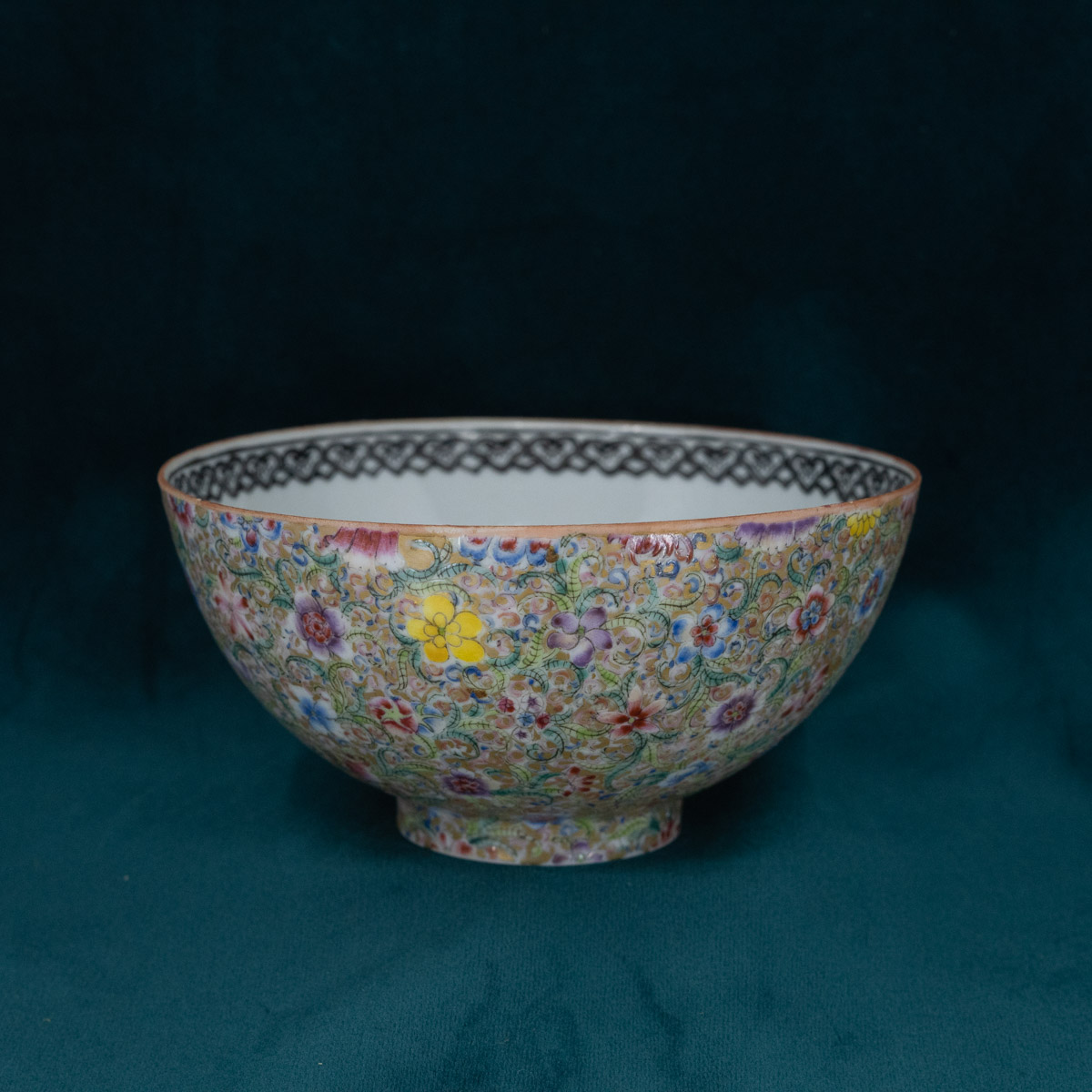
Chinese Eggshell Famille Rose "Thousand Flowers" Bowl
Collectibles
Approximate Replacement Value at time of purchase
$1,800.00
Summary
This is a Chinese eggshell-porcelain famille rose bowl, approximately 12.7 cm (5 in.) in diameter and 7 cm (2.75 in.) high, decorated on the exterior with a dense "thousand flowers" (millefleur) pattern on a gilt ground and on the interior with a grisaille dragon medallion, a grisaille ruyi-scroll rim border, and an iron-red rim line. The base carries a hand-painted four-character underglaze-blue "Qianlong nian zhi" (乾隆年製) mark within a ruled square cartouche. Detailed examination of the potting, glaze, enamels, pigments, gilding, and decorative program indicates a high-quality, entirely hand-decorated object whose reign mark is apocryphal (honorific) rather than of the period.
Points of analysis and findings
Reign mark — Four-character blue "Qianlong nian zhi" mark, hand-painted, precise, with an iridescent halo, set in a ruled square cartouche. Finding: reign marks were copied across all later periods and are not evidence of date; the blue four-character-mark-in-a-square format is the signature convention of Republic-era millefleur eggshell ware. Read as apocryphal, not mark-and-period.
Body / potting — Eggshell porcelain, ~1.25 mm thick, exceptionally thin and translucent. Finding: confirms master-level potting; eggshell famille rose was produced from the 18th century through the Republic and later, and has been heavily reproduced since c. 1916.
Glaze — Faint pooling on the white underside, visible only in good light; possible slight greyish cast, not clearly present. Finding: hand-applied (not sprayed) glaze, consistent with traditional production; tone inconclusive for dating.
Foot / base — Remarkably clean footrim, little to no wear, no kiln scar or grit. Finding: neutral-to-cautionary; removes the natural firing/wear markers expected on a 250-year-old piece, though forgivable for a carefully kept display object.
Enamels (raised) — Famille rose overglaze enamels, hand-applied and palpably raised. Finding: rules out transfer-printed/decal decoration; confirms hand-painting.
Purple pigment — Heterogeneous under magnification; resolves into discrete red, blue, and yellow mineral grains. Finding: hand-mixed mineral enamel — a traditional, early-leaning preparation.
Green pigments — Two shades (one bright yellow-green, one cool bluish "evergreen"), both notably finer and more homogeneous than the other colors. Finding: the fine, single-compound character indicates purified/chemical pigment; the bluish green fits the chrome-based green class that postdates the Qianlong period (19th century onward). The strongest single indicator of a later date; XRF for chromium would confirm.
Gilding — Gold is granular, bumpy, and rough under magnification. Finding: traditional powdered-gold, fired-and-burnished technique (not smooth modern "liquid bright gold"); consistent with traditional workshops of either the 18th century or later.
Black detailing — Fine black brushwork laid over the raised enamels. Finding: layered, multi-firing hand-painting; confirms high-quality traditional handwork.
Decoration / style — Exterior: dense millefleur on a gilt ground. Interior: grisaille (mo cai) dragon medallion, grisaille ruyi-scroll border, iron-red rim line. Finding: the specific combination — millefleur gilt-ground eggshell + grisaille dragon medallion + blue Qianlong mark in a square — is a well-documented late Qing (Guangxu) to Republic decorative formula.
Central dragon — Grisaille, ink-shaded (Western-influenced modeling), coiled in a foliate roundel; stylized and decorative rather than a bold five-clawed imperial dragon; claw count indeterminate. Finding: a decorative (non-imperial) treatment consistent with late Qing/Republic export-influenced production.
Market / type context — This is among the most reproduced eggshell famille rose categories. Finding: genuine 18th-century imperial eggshell would be a six-to-seven-figure object; this type realistically sits in the low-hundreds to low-thousands range, subject to condition and confirmed dating.
Likely attribution
Taken together, the evidence points to a high-quality, hand-decorated Chinese eggshell famille rose "thousand flowers" bowl, most likely of the late Qing (Guangxu period, 1875–1908) to Republic period (1912–1949), c. late 19th–early 20th century, bearing an apocryphal Qianlong reign mark — not an 18th-century imperial piece. The traditional materials (powdered burnished gold, hand-mixed mineral purple, hand-painted haloed mark) place it above ordinary commercial reproductions, while the chemical-type green pigments, the grisaille dragon vocabulary, and the blue-mark-in-a-square millefleur format all point to the later dating. Final confirmation pending in-hand examination by a Chinese ceramics specialist and, ideally, non-destructive XRF pigment analysis (specifically to test the bluish green for chromium).
Record of Provenance
Purchased by Raven's Nest from the estate of Bliss Hebert and Allen Charles Klein in June of 2026
This information was gathered and recorded by The Raven's Nest.
We research every piece and share what we've learned to the best of our knowledge. We do our best never to misrepresent an item, though for older and one-of-a-kind pieces some details can't be known with certainty. If you have questions about this piece, we'd be glad to take a closer look with you in person — you're always welcome to bring it by the shop.
Questions about this piece? Email us →