1915 – 1935
Art Deco engagement rings.
Art Deco is the ring aesthetic almost everyone can picture without knowing the name. Geometric, symmetric, bold contrasts of platinum and colored stones. If you've seen a 1920s or early 1930s engagement ring in a photograph and thought it looked like architecture on someone's finger — you've seen Art Deco.
It's one of the most consistently sought after periods for vintage engagement rings, and one of the periods we look hardest to acquire for the cases in Pike Place Market.
In the cases now
The Art Deco ring here today.
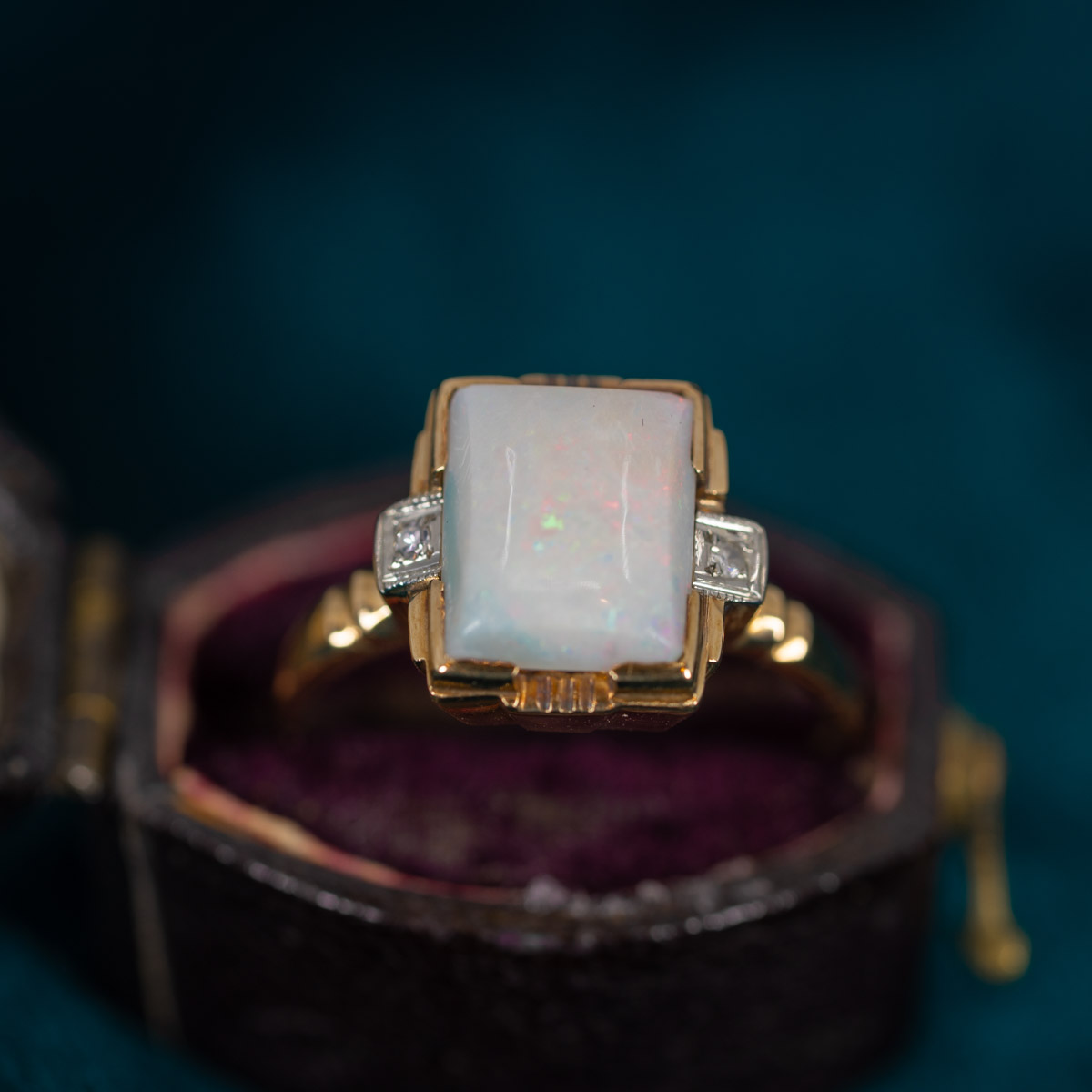
No pieces match that combination.
Try clearing a filter or two.
What makes a ring genuinely Art Deco.
- Symmetry over organic lines. Where the Edwardian era favored lace and garlands, Art Deco favored the ruler and the compass. Chevrons, sunbursts, stepped shoulders, mirrored geometry.
- Bold contrast. Platinum or white gold against a colored stone — sapphire, emerald, ruby — or against diamonds set in strict geometric patterns.
- Machine-age motifs. Skyscrapers, zigzags, radial rays, stepped pyramids. The influence of the 1925 Paris Exposition is on almost every genuine piece.
- Millegrain. A fine beaded border around stones and along the edges of settings. Common in Art Deco and one of the surest signs a ring is period rather than reproduction.
- Baguettes as side stones. The now-classic pairing of a center stone with baguette-cut diamond accents originated here.
Stones and cuts of the period.
Diamonds in Art Deco engagement rings are almost always Old European Cut or transitional cuts — the modern round brilliant we know today wasn't standard until the late 1930s. Old European Cuts have higher crowns, open culets, and hand-cut facets that catch light differently than any machine-cut stone.
Sapphires — deep royal blues and Kashmir-adjacent cornflowers — are the most common colored center stone, followed by emeralds and rubies. Baguette-cut diamonds show up frequently as side stones and shoulder accents.
Platinum dominates the metal count. 18k white gold appears too. Yellow gold Art Deco rings exist but are rarer.
What we look for when we vet one.
- The metal. Genuine period rings are usually hallmarked platinum or 18k white gold. Anything stamped sterling is almost certainly a later reproduction.
- The cuts. Old European Cut diamonds have a specific character — the modern round brilliant is a giveaway that a ring is Art Deco style, not Art Deco era.
- Setting condition. Millegrain wears down over a hundred years. Some wear is expected and adds character; complete loss can indicate a restoration heavy enough to matter.
- Resizing risk. Some Art Deco settings can't be resized more than a half-size without disturbing the design. We'll tell you honestly what's possible before you commit.
Other eras worth a look.
1901 – 1915
Edwardian
Lace-like platinum, filigree, garland motifs. The era right before Art Deco's boldness.
Browse Edwardian →1837 – 1900
Victorian
Symbolism-forward. Snakes eating tails, hands clasped, sentimental motifs in gold.
Browse Victorian →All rings
Engagement rings
Everything in the cases — vintage, antique, and custom paths.
All rings →Come see them in person
Art Deco is best seen in the hand.
Photos catch the geometry but miss the light. We're in Pike Place Market, beside Rachel the Pig — open every day.