1901 – 1915
Edwardian engagement rings.
The Edwardian era is when jewelry-makers first got to work with platinum at scale. That single fact shaped everything else about the style. Platinum could be cut, filed, and pierced into designs that would collapse if attempted in gold — lace-like galleries, floating diamonds, filigree so fine it looks impossible to have made by hand.
Which, in the early 1900s, is exactly what it was.
In the cases now
The Edwardian ring here today.
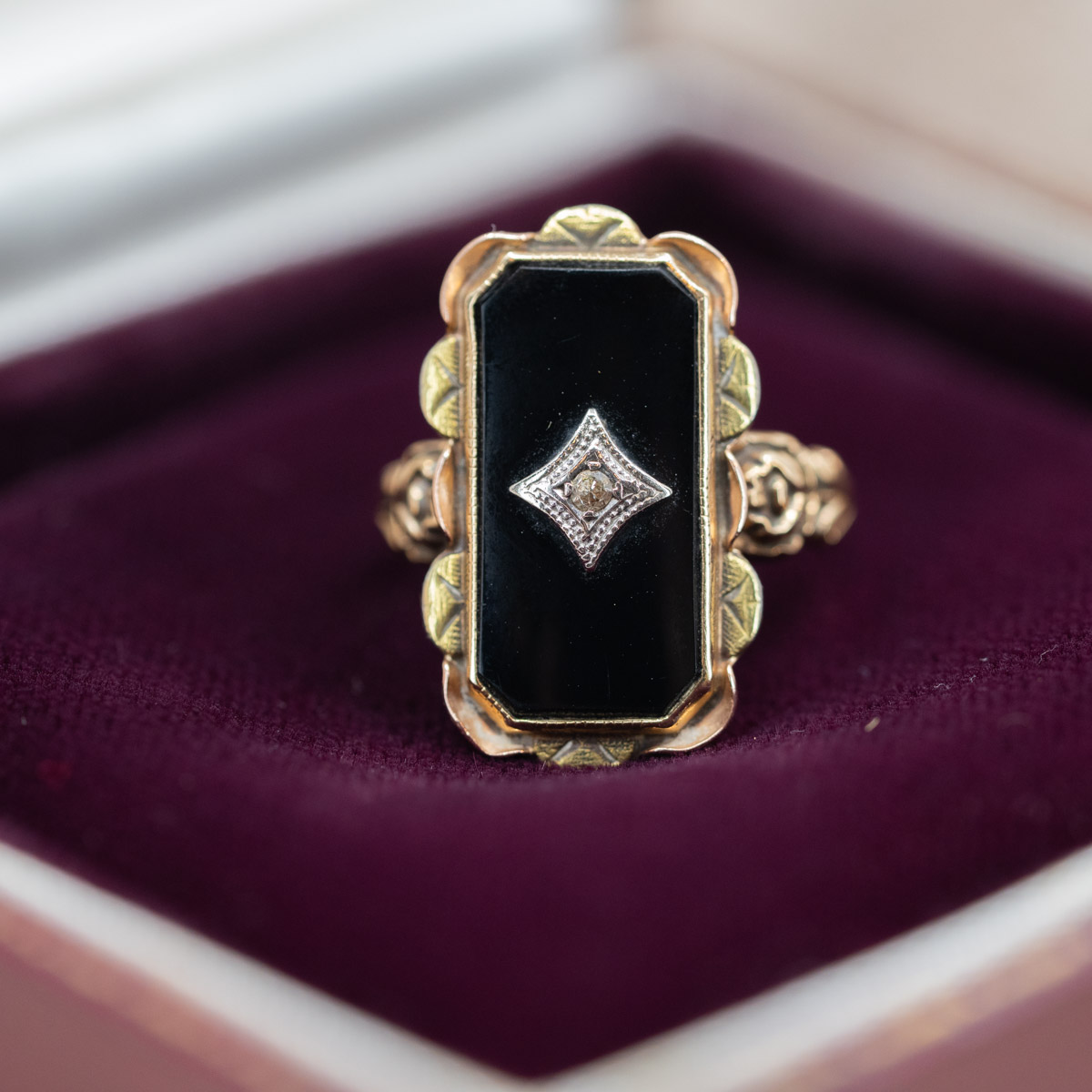
No pieces match that combination.
Try clearing a filter or two.
What makes a ring Edwardian.
- Delicate, almost lace-like white metal work. Platinum first, sometimes white gold. Never yellow-gold-forward the way Victorian rings often are.
- Garland motifs. Laurel wreaths, ribbons, bows, floral clusters. The Edwardian era carried a bit of Belle Époque aesthetic — soft, decorative, generous.
- Openwork galleries. The undersides of Edwardian settings are often as detailed as the tops — pierced patterns you only see when the ring is off the finger.
- Millegrain everywhere. Fine beaded borders along every edge. Where Art Deco used millegrain as an accent, Edwardian used it as a rule.
- Low profile. Edwardian rings often sit closer to the finger than later eras — a byproduct of Rose Cut diamonds being flat-bottomed.
Stones and cuts of the period.
Diamonds in Edwardian rings are typically Old European Cut, Old Mine Cut, or Rose Cut. Rose Cuts — flat-bottomed and faceted only on top — are especially characteristic of the era, and give Edwardian pieces a distinct low, quiet quality that modern round brilliants can't replicate.
Colored stones show up occasionally — sapphires most often — but the era favored diamond-forward compositions in white metal. Where Victorian rings said "here is a story"; Edwardian rings said "here is light."
The transition from Edwardian to Art Deco happened around 1915. Later Edwardian and earliest Art Deco pieces can be genuinely hard to place — some rings straddle both eras, and honest dealers will admit it when they do.
What we look for when we vet one.
- Structural integrity of the filigree. A century of wear can weaken fine platinum work. We check that a ring is intact and safe to wear daily.
- Rose Cut evaluation. Rose Cuts don't grade on modern GIA criteria — their beauty is in shape, symmetry, and light performance rather than a modern brilliance report. We tell you what to look for.
- Sizing tolerance. Some Edwardian rings can't be resized more than a quarter-size without compromising the design. We'll tell you what's possible before you commit.
- Missing stones. Old settings sometimes have empty prongs where a stone was lost decades ago. Some are restorable; some are best left alone.
Other eras worth a look.
1915 – 1935
Art Deco
Geometric, symmetric, high-contrast. The era after Edwardian — bolder in every way.
Browse Art Deco →1837 – 1900
Victorian
Symbolism-forward. Snakes eating tails, hands clasped, sentimental motifs in gold.
Browse Victorian →All rings
Engagement rings
Everything in the cases — vintage, antique, and custom paths.
All rings →Come see them in person
Edwardian is best seen in the hand.
Rose Cuts especially — photos flatten them. We're in Pike Place Market, beside Rachel the Pig — open every day.